
Product Profile
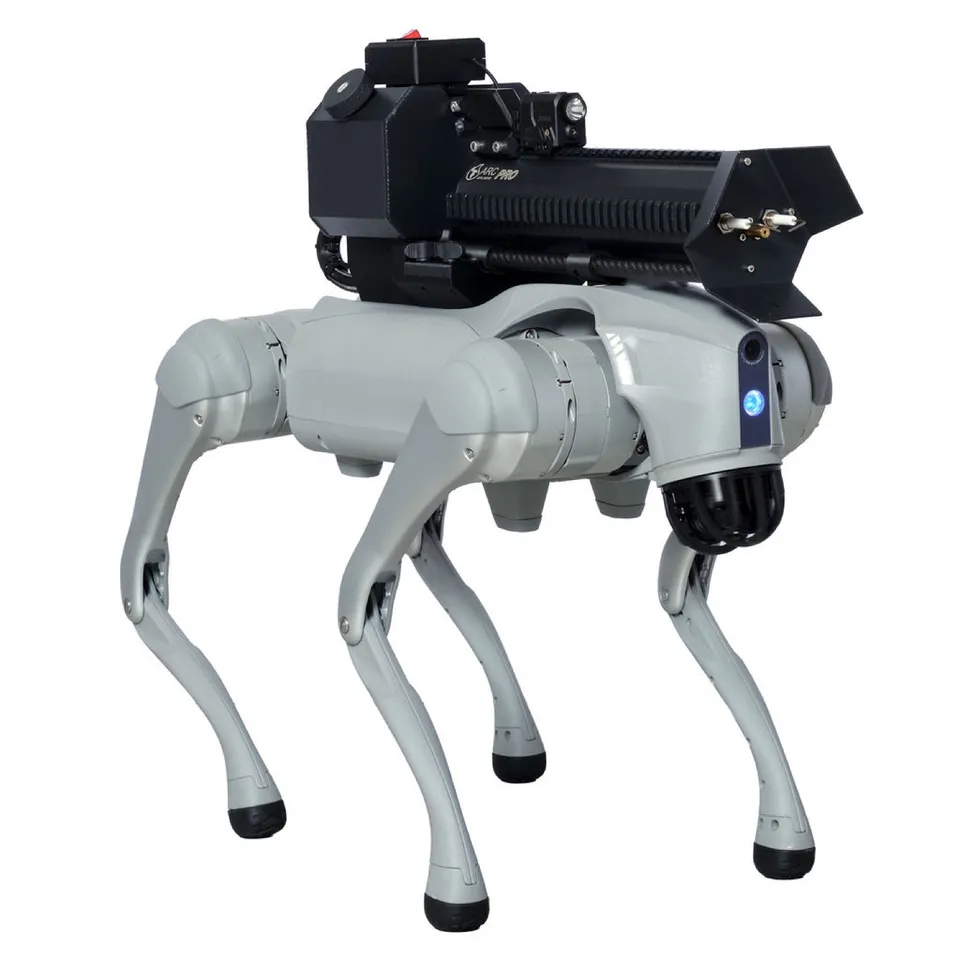
Throwflame Thermonator: The Flamethrower Robot Dog
The Thermonator is Throwflame's flamethrower-armed robot dog, and the first flamethrower-wielding robot quadruped ever sold commercially. It pairs a walking, lidar-guided chassis with an integrated version of Throwflame's ARC flamethrower, and it sells direct at throwflame.com for $9,420. As of July 2026, it is in stock.
This profile covers what the machine actually is, the specs that matter, where it earns its keep beyond the spectacle, and what to weigh before spending this kind of money. As always, this is a best-effort guide from enthusiasts, not a substitute for the manufacturer's documentation.
Buying Snapshot
- For sale
- $9,420 direct retail
- In stock on official product page
- 🇺🇸 United States (Cleveland, Ohio)
What the Thermonator is
The Thermonator is a four-legged robot with a flamethrower mounted on its back. Throwflame, the Cleveland, Ohio manufacturer behind the XL18 and X15, builds it around an integrated version of its ARC flamethrower, which gives the unit a 30 ft firing range on gasoline or a gasoline-diesel mix. It is not napalm compatible, so thickened-fuel range tricks are off the table.
The whole machine weighs 37 lbs and measures 30 by 20 by 20 inches, small enough to ride in a truck bed or a large case. It walks, maps its surroundings with onboard lidar, avoids obstacles on its own, and aims with laser sighting while the operator watches a first-person video feed on the handheld controller.
Throwflame sells it direct at throwflame.com for $9,420 with free UPS Ground shipping and the company's lifetime warranty, and it is in stock as of this writing.
Specs, control, and battery life
Control runs over WiFi and Bluetooth at up to 350 ft line of sight, with FPV video streamed to the handheld controller. That 350 ft standoff is the number that changes what a flamethrower can do: the operator can stand well clear of the fire, the terrain, or both. Onboard lidar handles mapping and obstacle avoidance, so the operator steers intent rather than micromanaging footfalls.
The chassis runs about an hour of active operation per charge, longer if the unit spends much of its time stationary, and a full recharge takes about 2.5 hours. The walking chassis and the ARC flamethrower run on separate batteries, so firing does not drain the legs and vice versa.
The learning curve is shorter than the machine's looks suggest. Operators typically have basic mobility and firing down within an hour of unboxing. Fuel is ordinary pump gasoline or a gasoline-diesel mix; napalm mixes are not compatible.
What it is actually useful for
The honest answer is that the Thermonator is two products in one. The first is a genuinely practical remote-fire tool. The second is the most talked-about piece of fire equipment money can buy, and some buyers are paying for exactly that. Both are legitimate reasons to own one; it helps to know which one you are.
On the practical side, the case for it is any burn where a human should not be walking: hazardous or unstable terrain, prescribed agricultural burns, brush management, and snow and ice clearing. With up to 350 ft of standoff and an FPV feed, the operator stays out of the smoke, the heat, and whatever the ground is hiding. Film and SFX work is the other established niche, since it puts a repeatable fire source on set without putting a crew member behind the nozzle.
What it is not is a range upgrade. The integrated ARC throws fire 30 ft, the same published range as the $699 handheld ARC. If raw reach or fuel volume is the goal, this is the wrong tool; the premium buys remote operation, not more fire.
Buying notes
Price context matters at $9,420. Throwflame's own XL18 costs $3,450 and publishes 110 ft or more of range with a napalm mix, which is several times the reach for roughly a third of the price. The handheld ARC and ARC Pro run $699 and $899 with the same 30 ft range as the Thermonator's integrated unit. Buy the Thermonator for the one thing only it does: putting fire somewhere without putting a person there. Both the standalone ARC and the Thermonator are in stock, sold direct.
For US civilian buyers the purchase itself is straightforward: direct from throwflame.com, free UPS Ground shipping, lifetime warranty. Buyers in those categories should plan for a compliance process rather than a simple checkout.
On legality, flamethrowers are federally unregulated and are not classified as firearms by the ATF. Maryland bans them outright, and California requires a State Fire Marshal permit for any device with more than 10 ft of range, which the 30 ft Thermonator exceeds. No other state has a statewide statute on the books, though bills are pending in New York and Illinois. Check local ordinances and burn regulations before lighting anything.
Frequently asked questions
How much does the Thermonator cost?
The Thermonator sells for $9,420 direct at throwflame.com, and it is in stock as of July 2026. The price includes free UPS Ground shipping, and Throwflame backs it with a lifetime warranty.
Is a flamethrower robot dog legal to own?
Federally, yes. Flamethrowers are unregulated at the federal level and are not classified as firearms by the ATF. Maryland bans flamethrowers entirely, and California requires a State Fire Marshal permit for devices with more than 10 ft of range, which covers the 30 ft Thermonator; other states have no statewide statute, though bills are pending in New York and Illinois.
What is the Thermonator's firing range?
The integrated ARC flamethrower fires about 30 ft on gasoline or a gasoline-diesel mix, and it is not napalm compatible. The operator can be up to 350 ft away line of sight, controlling the unit over WiFi and Bluetooth with FPV video on the handheld controller.
How hard is the Thermonator to operate, and how long does it run?
Operators typically manage basic mobility and firing within an hour of unboxing, with onboard lidar handling mapping and obstacle avoidance. Expect roughly an hour of active operation per charge, longer when stationary, with a full recharge in about 2.5 hours. The flamethrower runs on its own battery, separate from the chassis.